By Fr. John Celichowski, OFM Cap., Interim Corporate Responsibility Agent
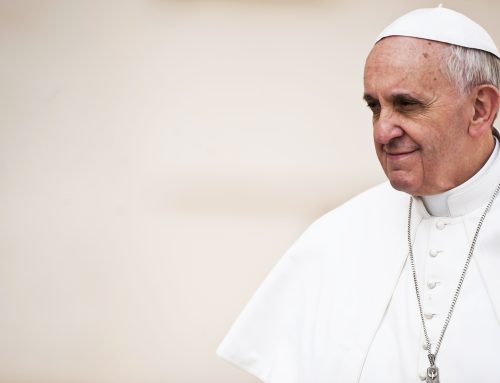
The Capuchin friars of the Province of St. Joseph join our fellow Roman Catholics and many other people throughout the world in mourning the death of Pope Francis. With Easter hope, we are even more grateful for his life and legacy.
From the moments he first stood on the balcony and greeted the world as the successor to St. Peter, Pope Francis set the tone for the next 12 years of his ministry as “the servant of the servants of God.” In considering the name Francis, he could have chosen as his patron a range of saints, including one who preceded him as a Jesuit missionary (St. Francis Xavier), one who was a wise and devoted pastor (St. Francis De Sales), and still another Jesuit who was a great educator (St. Francis Borgia).
Instead, he chose St. Francis of Assisi, il poverello. That choice reflected and shaped his ministry as Pope, which was marked by his reverence for and defense of creation (most notably in his encyclical Laudato sí, inspired by the Canticle of the Creatures), as well as his reverence for and defense of the dignity of all persons, especially those who are pushed to the margins of society: those who are poor, elderly, migrants, refugees, the victims of war, prejudice and various forms of exploitation, and many others.
Along with St. John Paul II and Pope Benedict XVI, his predecessors, Pope Francis ardently believed that the primary purpose of any economic system is to serve human needs and enhance human dignity. In his 2020 encyclical Fratelli tutti he wrote:
Business activity is essentially “a noble vocation, directed to producing wealth and improving our world.” God encourages us to develop the talents he gave us, and he has made our universe one of immense potential. In God’s plan, each individual is called to promote his or her own development, and this includes finding the best economic and technological means of multiplying goods and increasing wealth. Business abilities, which are a gift from God, should always be clearly directed to the development of others and to eliminating poverty, especially through the creation of diversified work opportunities. The right to private property is always accompanied by the primary and prior principle of the subordination of all private property to the universal destination of the earth’s goods, and thus the right of all to their use (123).
With many other faith-based investors, the Province of St. Joseph believes that return on investment is calculated not only in financial terms but also in moral and human terms and as such necessarily includes consideration of environmental impacts, social responsibility, sound governance and other factors. We recall that on the eve of his election, Pope Francis asked for the prayers of all those gathered in St. Peter’s Square and beyond, kneeling before them. Today we kneel in prayer for him and the repose of his soul, and asking him to intercede before God for the Church and the world.